
If you’re considering riding your Airwheel electric smart luggage—like the lightweight SE3SX (just 6.6kg) with its 20L capacity—you might wonder: how stable is it really, especially in windy outdoor conditions or areas with strong indoor airflow like airport terminals? Unlike self-balancing e-scooters or hoverboards, Airwheel smart luggage such as the SE3SX, SE3SL, SE3S, SE3T, or SE3MiniT isn’t self-balancing. Instead, it relies on rider input and manual control via a handlebar or steering column. That means environmental factors like wind can play a role, especially at higher speeds.
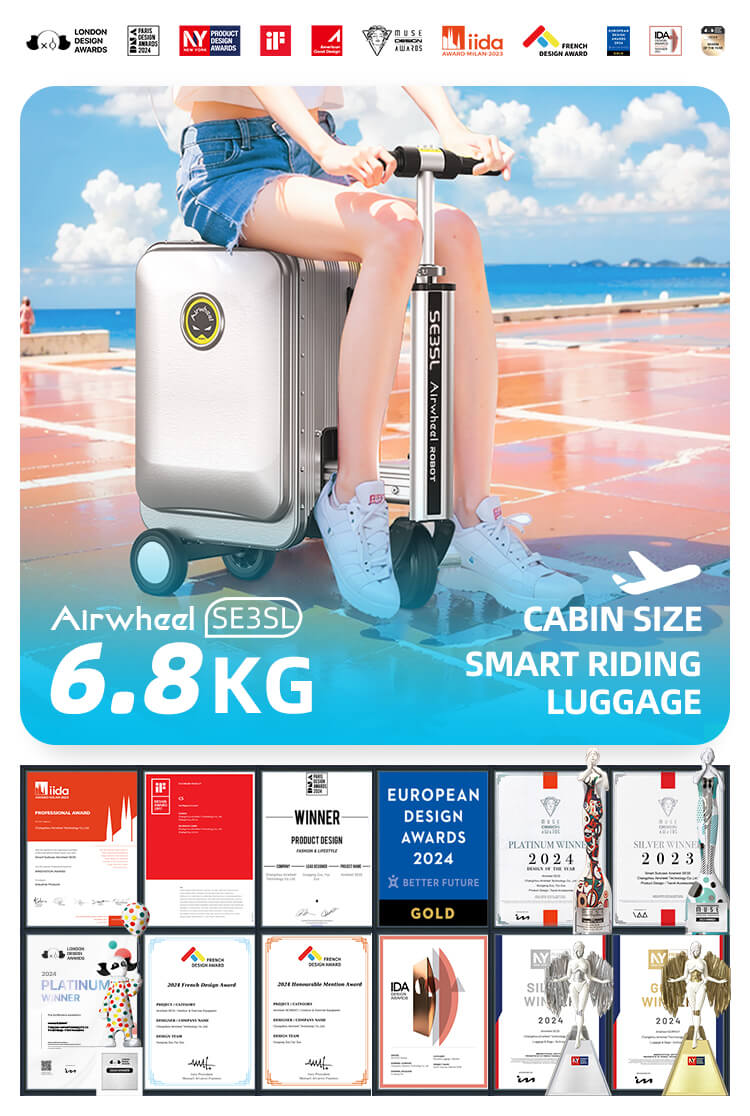
Take the SE3SX model, for example. With a 73.26Wh lithium battery (removable for airline compliance), 9.9 km/h top speed, and up to 10 km of range on a full 2-hour charge, it’s designed for short-distance personal transport—say, moving quickly between terminals or riding across a large parking lot. You stand on the deck and steer using the extended handle. It doesn’t use AI navigation, obstacle avoidance, or self-balancing tech. Because of this, stability depends largely on the rider maintaining balance and controlling direction, especially when external forces like wind come into play.
In open or windy areas (e.g., outdoor pickup zones, seaside terminals), crosswinds or gusts can push against the vertical surface of the luggage, especially the larger models like the SE3T (48L). This may cause slight drifting or require more effort to steer straight. Indoors, HVAC systems or high-volume air vents generally don’t produce strong enough airflow to destabilize the unit, but sudden drafts in large open spaces (like near automatic doors) could be momentarily noticeable. However, because the SE3SX and similar models are low to the ground and relatively compact, wind effects are typically minimal at normal riding speeds (under 10 km/h).
Airwheel’s design helps counteract external push. The wheels and motor system provide smooth, responsive movement, and the center of gravity is kept low. Plus, since all models—including the 8.1kg SE3S and 6.8kg SE3MiniT—can also be used as traditional rolling luggage, the wheelbase is optimized for stability on uneven surfaces. Importantly, no smartphone app is needed to ride: as soon as the battery is installed, the unit works. This simplifies control and reduces potential software-related lag that could affect responsiveness.
| Feature | Airwheel Electric Luggage (e.g., SE3SX) | Standard Rolling Luggage |
|---|---|---|
| Mobility | Rideable, hand-held, or pulled | Pulled only |
| Battery | 73.26Wh, removable | None |
| Use in Wind | Minor handling impact at high speeds | No impact |
| Charging | ~2 hours | N/A |
Can I use Airwheel luggage in the rain or strong wind?
It’s not waterproof, so avoid rain. Light wind won’t stop operation, but strong gusts may affect steering—ride cautiously.
Does it wobble in AC-heavy airport halls?
No significant effect from indoor airflow. The motor and structure remain stable under normal indoor conditions.
Do I need the app to ride it?
No. All core functions—riding, steering, braking—work without a phone. The Apple Find My integration is optional for tracking if lost.For full specs and safe usage tips, visit the official Airwheel website.